


You moved to New York City expecting opportunity at every corner. Instead, you feel invisible. That experience is more common than you think, and understanding why newcomers struggle networking in NYC is the first step toward doing something about it. 40% of NYC residents report feeling lonely, and for newcomers without an established social foundation, the city's scale works against you rather than for you. This article breaks down the real reasons networking feels so hard here, the mistakes that make it harder, and what actually works.
The city's size creates a paradox. More people, more events, more industries. Yet Gen Z professionals have a median of 16 strong connections compared to 40 for Gen X. That gap is not about effort. It reflects structural and cultural realities that hit newcomers hardest.
The networking challenges for newcomers begin before you even walk into a room. NYC's job market has tightened significantly. Since 2022, the city has seen a 37.4% decline in entry-level job postings, which means more people are competing for fewer footholds. That pressure bleeds into every networking interaction, making conversations feel loaded and high-stakes before they start.
Cultural and communication barriers add another layer. For immigrants and international newcomers, soft skills like eye contact and conversational volume can be misread by locals. What reads as confident directness in one culture can feel abrasive in another. These mismatches are rarely discussed openly, which means newcomers often walk away from interactions not knowing what went wrong.
Then there is the city's pace itself. NYC social culture moves fast and often performs connection rather than creating it. Events are loud, crowded, and structured around quick exchanges. For someone without a local anchor, that environment rewards the already-connected and leaves newcomers cycling through the same surface-level conversations.
Most networking advice focuses on tactics. What it misses is the mindset errors that derail newcomers long before they try any tactic. Here are the most damaging ones:
Pro Tip: Before your next event, write down one specific thing you want to learn from the people you meet. That single shift moves you from "pitching" mode to "curious" mode, and people respond to curiosity far more warmly than to ambition.
The good news is that the same city creating these challenges also offers unusually rich resources for those who know where to look. Here is what actually works for newcomers.
Effective networkers avoid asking for jobs on first contact, instead using informational interviews to build social capital gradually. Ask someone how they got into their field, what they wish they had known earlier, or what they find most interesting about their work right now. These questions open conversations. Job requests close them.
Smaller, niche community pockets consistently outperform broad networking events for newcomers. A monthly book club in your industry, a volunteer project in your neighborhood, or a recurring arts event will introduce you to the same people multiple times. Repetition builds familiarity. Familiarity builds trust.
Remote work has changed how connections form. Digital-only networking reduces the informal interactions newcomers rely on to get established. The most effective approach post-pandemic combines a consistent online presence with deliberate in-person attendance at smaller, recurring events.
Here is a quick comparison of approaches that work versus those that drain energy without results:
Arrive early. The first 15 minutes of any event are the easiest for conversation because the room is not yet overwhelming and people are still settling in. Work the edges of the room rather than the center. Take micro-breaks outside or near a quieter corner to reset. These are not workarounds. They are genuinely smart tactics for anyone who finds large social environments draining.
Pro Tip: If overcoming networking anxiety in NYC feels like a wall, commit to attending the same event three times before judging it. Most meaningful connections happen on the second or third encounter, not the first.
Nobody talks honestly about how exhausting the early months of networking in NYC can feel. The loneliness is real. The social plateau phases, where you have met people but do not yet feel genuinely connected to any of them, are normal and temporary.
"Depth of connection matters far more than quantity. One person who genuinely knows you is worth twenty business cards in a drawer."
A few things worth holding onto when the process feels slow:
Give yourself permission to build slowly. The people who stick around in NYC's social scene are almost always the ones who stopped trying to rush it.
Most newcomer networking tips NYC guides point you straight to industry mixers and professional associations. Those have their place, but they are rarely where the most authentic connections form. Here is a more honest breakdown of your options:
The format that consistently works best for newcomers who want depth over volume is the small, curated gathering built around a shared interest. You show up as yourself, not as your elevator pitch. That distinction changes everything.
I've watched a lot of people arrive in New York full of energy and leave their first year feeling like they failed at something everyone else seemed to find easy. What I've learned is that the conventional wisdom on NYC networking misses the emotional reality almost entirely.
Most advice tells you to be bold, follow up fast, and attend everything. In my experience, that approach burns people out within three months. What actually works is something quieter. I've seen the most unexpected opportunities come from a single repeated connection, someone you kept running into at the same gallery opening or the same small dinner, who eventually became a genuine collaborator or friend.
What I'd tell any newcomer is this: stop measuring your network by its size. Measure it by how many people in that list would actually pick up the phone if you called. For most people, that number starts at zero and builds to something meaningful only through time and genuine interest in other people. NYC rewards that patience. It just takes longer than anyone tells you it will.
If the traditional networking circuit has left you feeling drained rather than connected, you are not alone and you are not doing it wrong. Sometimes the format is simply the wrong fit.
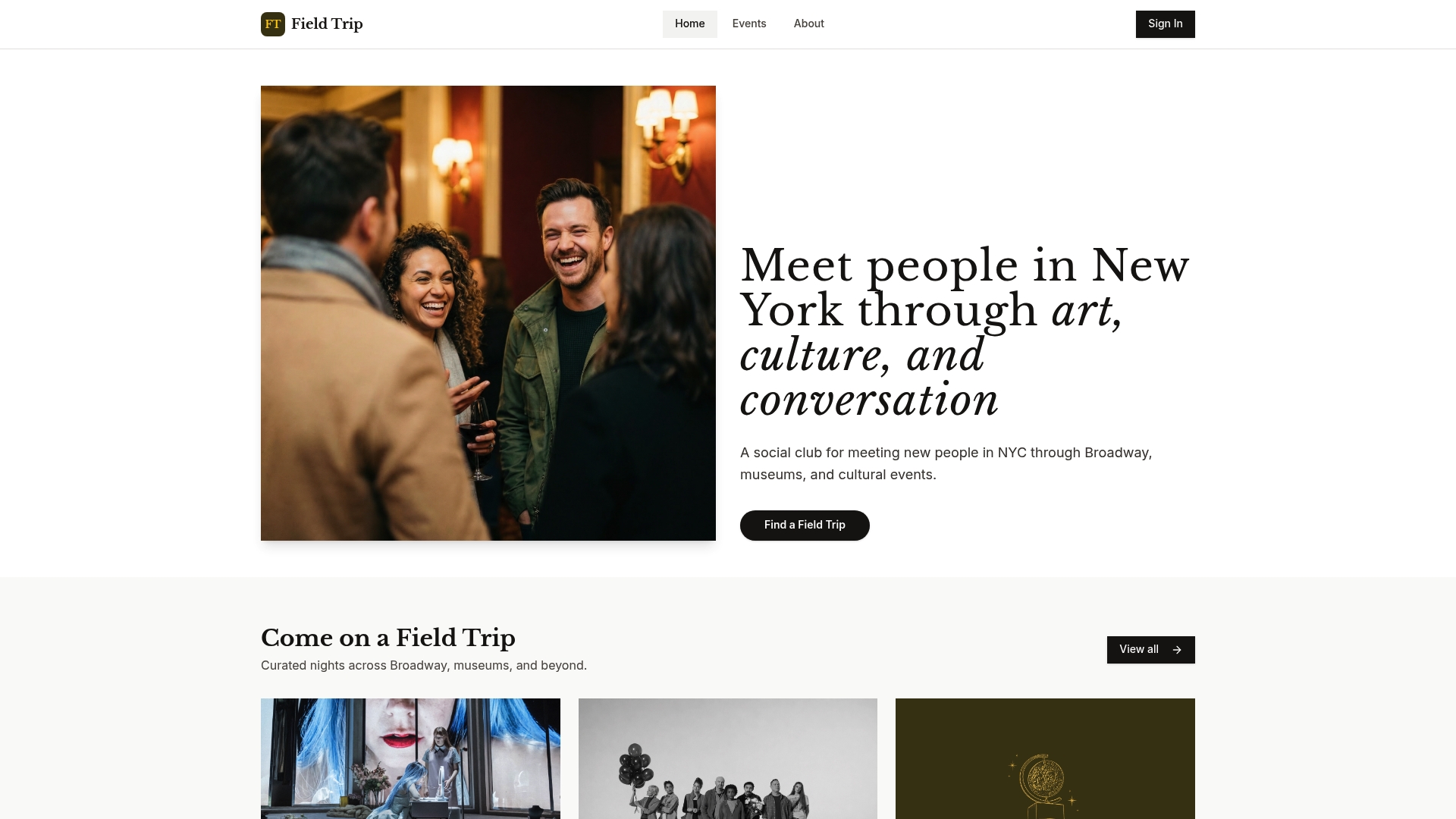
Field Trip is a social club built around exactly the kind of small, curated gatherings that work best for newcomers. With an average of 12 people per outing, from Broadway shows to museum visits, every event gives you something real to experience together before you ever have to introduce yourself. There is no pitch, no name tag pressure, no agenda beyond a genuinely good evening. If you are ready to meet people in a way that feels natural rather than forced, explore upcoming events and see what is coming up next.
40% of NYC residents report loneliness, and newcomers without an existing social network feel this most acutely. The city's fast pace and large-scale social events make it hard to form the repeated, low-pressure contact that builds real friendships.
Expecting quick results, pitching instead of listening, and attending too many events without follow-up are the top mistakes. NYC networking rewards patience and consistent relationship-building over aggressive self-promotion.
Introverts do best in smaller, recurring, interest-based settings rather than large mixers. Arriving early, choosing niche groups, and focusing on depth over quantity consistently produces better results than forcing yourself into formats that drain your energy.
Most newcomers start seeing meaningful connections form after six to twelve months of consistent, low-pressure engagement. Rushing the process or expecting results within weeks is the single biggest reason people give up too soon.
Yes, and they are underused. Shared cultural experiences give everyone in the room an immediate, genuine topic of conversation. Small, curated gatherings built around art, theater, or music tend to produce deeper connections than traditional professional events.