

New York has no shortage of things to do. The harder part is finding people to do them with.
For a city of 8 million, loneliness is surprisingly common here. Friend groups that formed in your 20s scatter. People move, pair off, get absorbed into work. You can go weeks without a real conversation that wasn't transactional. And if you've recently moved to New York, or just find yourself wanting more than your existing circle offers, it can feel like everyone else already has their people figured out.
Social clubs have quietly become one of the best answers to this problem. They give you a reason to show up somewhere, around people who also made the conscious choice to show up. That shared intention changes the whole dynamic. It makes the room less awkward. It makes connection more likely.
This guide covers the best social clubs in NYC right now, from arts and culture groups to curated dinner clubs to private members clubs. Whatever you're looking for in New York, there's probably a group built around it.
The term "social club" gets used loosely. It helps to understand what the different models actually are before you start signing up for things.
Private members clubs are physical spaces you pay to access. Think Soho House or Zero Bond. You're paying for the rooms, the amenities, and the community of people who also belong. These tend to be on the expensive side and skew toward creatives and professionals.
Curated social groups organize events around shared experiences. Activities, dinners, outings. The idea is that you meet people through doing something together rather than mingling in a room. Field Trip, 222, and Timeleft fall into this category.
Dinner clubs like Timeleft organize group meals between strangers, often using some kind of matching algorithm to build compatible tables. Simple, low-pressure, and surprisingly effective.
Activity and interest clubs are organized around something specific (fitness, arts, professional networking). The activity is the structure; friendship is the byproduct.
This guide focuses on clubs where the goal is actually meeting people. Not just showing up to a nice room, but leaving with connections.
Field Trip is an arts and culture social club for people in their 20s, 30s and 40s who want to explore the city and actually meet people while doing it. The idea is simple: instead of going to a Broadway show or gallery opening alone, you go with a small group of people you haven't met yet.
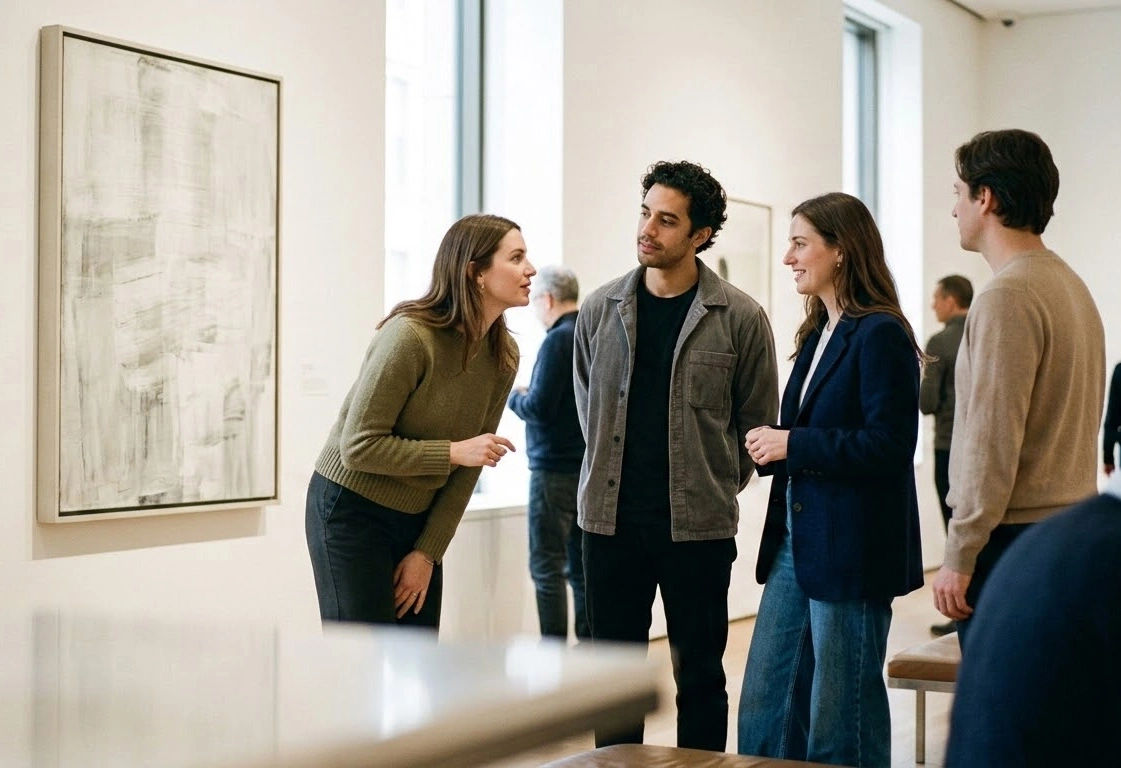
Events are kept deliberately small. A group of eight or ten people attending an opening at the Whitney, or a matinee at Lincoln Center, or a new production on Broadway. The size matters. When you're not swallowed by a crowd, you actually get to talk to people. The conversation starts naturally, around whatever you just experienced together.
Field Trip attracts people who love New York but want more from it than just attendance. They're curious, culturally engaged, and tired of doing things solo. The events rotate across Broadway, museums, galleries, and dance performances, so there's always something coming up.
If you find yourself googling "things to do in NYC" and then not going because you have no one to go with, Field Trip is worth checking out.
Best for: Arts and culture lovers who want to meet like-minded people through shared experiences.
Timeleft takes a pleasingly audacious approach: it matches you with five strangers for dinner at a restaurant in your neighborhood. You take a short personality quiz when you sign up, and the algorithm builds your table based on compatibility, age range, and energy. The restaurant is revealed the morning of.
There's something about the ritual that works. It's not a special occasion, which removes pressure. You're just having dinner with some interesting people on a weeknight. The app provides icebreaker prompts if the conversation ever needs a nudge, but most tables don't seem to need them.
It's not for everyone; there's real variance in who shows up on any given week. But for people who are willing to embrace a little uncertainty, Timeleft is one of the most direct routes to meeting strangers in New York.
Best for: Anyone who likes the idea of dinner with strangers and doesn't need the event to be perfectly curated.
OutClose (formerly Gayborhood) is a curated social dining club specifically for LGBTQ+ New Yorkers. Founder Cody Bumbarger created it after struggling to find ways to meet queer people where the existing avenues didn't feel like a fit. The result is something more like a dinner party than a bar night: curated dinners at restaurants in Chelsea, Hell's Kitchen, and Williamsburg, with a focus on genuine conversation over surface-level socializing.
The community focus is what sets it apart from general social clubs. People who join OutClose are specifically looking for queer community, not just any community, and the dinners reflect that intention. Events draw a mix of ages and backgrounds, with the connective tissue being shared identity and a desire to actually know the people in the room.
Best for: LGBTQ+ New Yorkers looking to build a queer social circle beyond bars and dating apps.
222 is a curated social experience app that organizes IRL events by matching people based on interests, values, and personality. It describes itself as an IRL marketplace facilitating social experiences at local venues and events through AI recommendations. It started in LA, relocated to New York, and has been building a following here among people in their 20s and 30s.
Events range from dinners to gallery visits to bar nights. The app curates your interests, hobbies, and values to pair you with like-minded people to explore new places and events throughout the city. Unlike Timeleft, which is purely dinner-focused, 222 tries to organize around a wider range of activities. You can find yourself at a Museum of Art brunch one week and a rooftop bar the next.
Best for: People who want algorithmically matched social experiences across a variety of NYC settings.
My Social Calendar is a membership-based events club with a specific focus: singles who want to meet people without the dynamic of dating apps. They host 22 to 24 events every month, covering a wide range of activities: trivia nights, wine tastings, concerts, cooking classes, hikes. Each event has a designated host who greets you, introduces you to others, and helps make sure the event feels welcoming.
It's not a matchmaking service, exactly, though it operates in that space. The point is getting you off the apps and into a room with real people.
Best for: Singles who want a structured social calendar with low pressure and a lot of options.
Soho House is the private members club that made private members clubs feel cool to people under 50. It started in London in 1995 as a club for people working in the creative industries (film, design, media, fashion, tech, the arts) and has since expanded to 40+ Houses worldwide.
The Manhattan location is in the Meatpacking District and includes workspaces, bars, a rooftop pool, a screening room, and a full events calendar. Membership is curated around creative contribution and community fit rather than job title alone. It's less "exclusive" in the old-money sense and more "selective about the kind of people it wants in the room."
It's expensive. And the waitlist situation in New York has been complicated in recent years. But if you work in a creative field, want a consistent space to work and socialize, and can afford it, Soho House still earns its reputation.
Best for: Creatives and media professionals who want a private space to work and socialize, and don't mind paying for it.
Zero Bond is one of the more quietly influential private members clubs in New York. Located in NoHo, it draws a mix of entertainment, media, finance, and tech people. The aesthetic is lush and dimly lit; it looks like someone designed a living room for a very stylish novel. Events include panels, dinners, and performances.
Where Soho House leans creative-industry-casual, Zero Bond feels slightly more polished. People come to be around other ambitious New Yorkers and to have the kind of conversations that only happen when you remove the general public from the equation. Membership is by application and referral.
Best for: Professionals who want a beautiful, well-curated space with a strong network of interesting people.
The right choice depends less on which club has the best branding and more on what you actually want from the experience.
If meeting people through culture and shared experiences is the draw, Field Trip is the most direct answer. You're not just attending an event, you're attending it with a small group of people who cared enough to sign up, which immediately differentiates it from going to a museum alone or sitting next to strangers at a show.
If you want something low-commitment and dinner-focused, Timeleft removes almost all the friction. You answer a quiz, book a ticket, and show up on. The algorithm does the rest.
If you want a physical home base in the city, Soho House or Zero Bond give you a place to work, eat, and bump into people organically over time. That kind of slow-build familiarity is underrated.
If you're LGBTQ+ and want queer community specifically, OutClose gives you that without having to translate across a more general social club.
The loneliness numbers have been hard to ignore for a while now. Remote work removed the ambient social contact that offices provided. Friend groups that formed in school or in early careers have become harder to maintain as people's lives diverge. And New York, for all its density, can be one of the lonelier cities in the world if you don't have the right hooks into it.
Social clubs work because they solve a specific problem: they give you a structured reason to be in a room with new people. The structure matters. Open networking events are anxiety-inducing because there's no shared context, no reason to approach someone. A group of eight people who all just watched the same play have an immediate, genuine thing to talk about. A table of six matched for dinner have already self-selected into something more than a crowd.
The other thing social clubs do is make showing up easy. When you pay for a membership or book a ticket, you're more likely to follow through. That's not a trivial function. A lot of people would like to meet new people in New York. Fewer actually manage it. The clubs that are growing right now tend to be the ones that remove friction while adding structure.
In a city of 8 million people, meeting the right ones still takes intention. New York doesn't do it for you. But that's almost the point; everyone here has made a deliberate choice to be in this specific difficult, expensive, endlessly interesting place, and that shared choice is a better basis for connection than most people realize.
If you love Broadway, museums, galleries, and the kind of conversation that happens after you've just seen something worth talking about, Field Trip is one of the most natural ways to meet people in New York right now. The events are small, the experiences are good, and the people who show up tend to be exactly the kind of people you'd want to meet.
What are the best social clubs in NYC? The best social clubs in NYC include Field Trip (arts and culture), Timeleft (weekly dinners with strangers), OutClose (LGBTQ+ community dinners), 222 (curated IRL experiences), My Social Calendar (singles events), Soho House (private members club for creatives), and Zero Bond (private members club in NoHo). The right one depends on what you're looking for: shared experiences, dinner with strangers, or a private space to call your own.
Are there social clubs in NYC for meeting new people? Yes, and it's arguably what most of them are built for. Clubs like Field Trip, Timeleft, 222, and OutClose are specifically designed around meeting people through shared experiences rather than open networking. The structure makes it much easier than trying to meet people at a bar or a general event.
What are private social clubs in NYC? Private social clubs in NYC are members-only spaces that require an application and ongoing membership fees. The most well-known are Soho House, Zero Bond, and Core Club. They offer physical spaces with lounges, restaurants, workspaces, rooftop pools, along with curated programming and a community of members. They tend to attract creatives, media professionals, and entrepreneurs, and typically cost anywhere from a few thousand dollars a year upward.
How do I meet people in NYC as an adult? Social clubs (or even young member programs at arts orgs) are one of the most effective options, precisely because they remove the ambiguity of trying to meet people organically. Beyond clubs, recurring activities (like a weekly class, a regular volunteer shift, a consistent sports league) create the kind of familiarity that help you meet people in NYC as an adult. The key is showing up to the same thing more than once.